


Five Things to Check Now the Clocks Have Gone Back

On Sunday 25 October, the clocks rewound back 1 hour and the UK loses that extra hour of daylight overnight. For anyone managing a school, care home, social housing scheme or commercial site, that sudden shift from light evenings to dark ones is one of the most predictable changes in the facilities calendar - and one of the easiest to get caught out by if you haven't walked the site with fresh eyes recently.
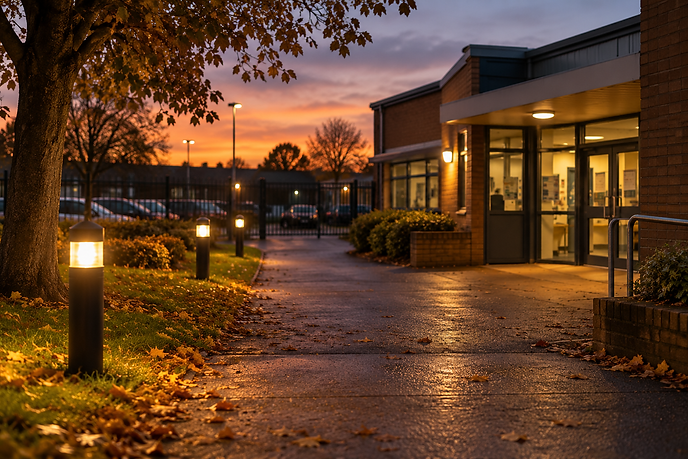
Here are five practical things worth checking this week, before the darker evenings arrive in earnest.
1. Lighting timers versus daylight sensors. If your car park, pathway or entrance lighting runs on a fixed timer rather than a daylight sensor, it's now switching on and off at the wrong times relative to when it actually gets dark. A timer set for last month's sunset will leave areas unlit for longer than you'd expect, right when visibility matters most. Daylight (photocell) sensors adjust automatically and are worth considering if you're still relying on timers in year-round need areas.
2. PIR sensors. Passive infrared sensors covering entrances, bin stores, car parks and walkways should be tested now, not assumed to be working. Check the detection range hasn't drifted, that nothing - new planting, a parked vehicle, a stored bin - is blocking the sensor's field of view, and that the light actually comes on quickly enough to be useful rather than lagging a few seconds behind someone's footsteps.
3. Entrance signage visibility. Signage that's perfectly legible in daylight can become almost invisible after dark if it isn't lit, reflective, or positioned where ambient light reaches it. Walk your main entrance at dusk this week and ask whether a visitor unfamiliar with the site could actually read it.
4. Dry, flat matting. Autumn brings wet leaves and rain in on every pair of shoes, and matting that's curling at the edges, soaked through, or simply too small for the footfall becomes a slip hazard fast - one that's harder to spot in low light. It's worth checking entrance matting at the same time as the rest of this list, since the risk compounds once the evenings are dark as well as wet.
5. Emergency lighting test. Emergency lighting exists precisely for situations where the normal lighting fails - and as the building is occupied for longer stretches in darkness, a fault that would have gone unnoticed in summer becomes a real risk. A quick functional test now, ahead of the darker months, is far better than discovering a fault during an actual outage.
None of these are expensive fixes if you catch them early. They're exactly the kind of thing that gets missed when everyone's attention is on bigger seasonal jobs - but they're also the kind of thing that turns into an incident report if they're missed for too long. Take twenty minutes this week to walk your site as it gets dark, and you'll have a clear list of anything that needs attention before the clocks change.
Trusted by schools, care homes and commercial sites across Yorkshire. Let us take the winter-readiness checks off your plate. Get in touch today.


Comments